
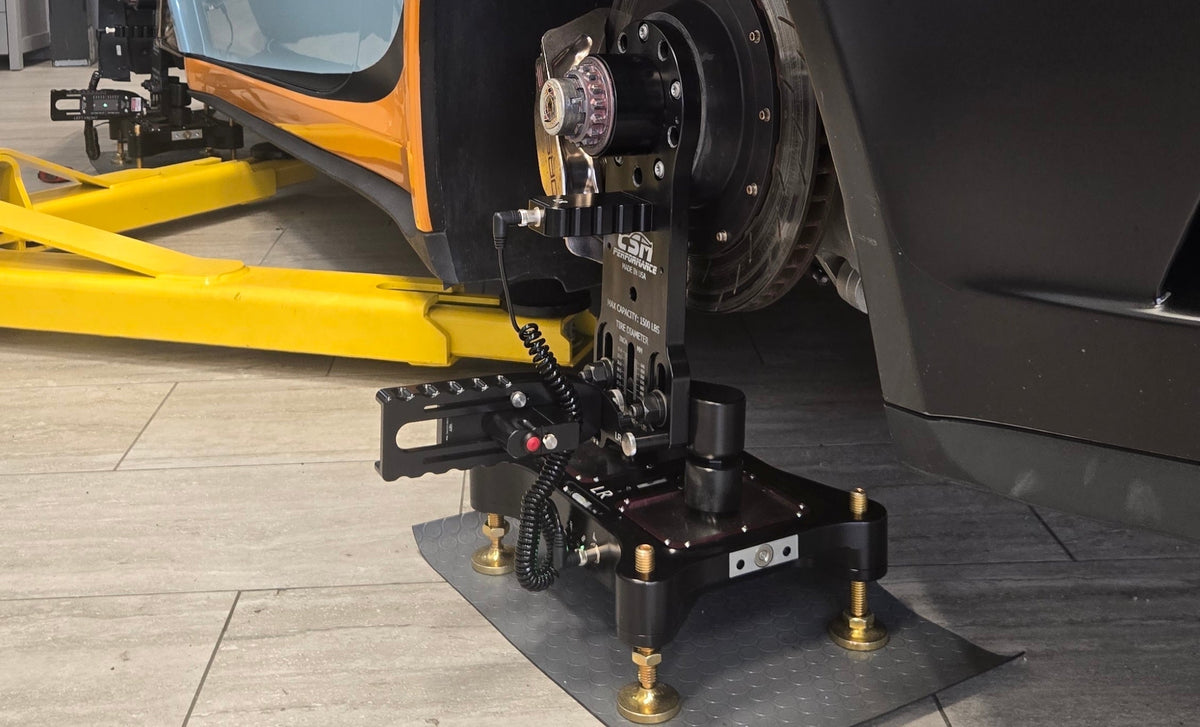
Every alignment method has to measure from something. Strings measure from the wheel. Toe plates measure from the wheel. Clamp-on heads, including the ones on six-figure shop systems, measure from the wheel or tire. The measurement can only ever be as good as the thing it references, and the wheel is the least accurate part of your setup.
The problem with the wheel
A wheel is not a reference surface. It is a consumable part that gets torqued on and off, curbed, heat cycled, and occasionally bent in ways you cannot see. Nearly every wheel carries some amount of runout. Every mounting introduces some amount of variance in how it seats against the hub. Every clamp-on measuring head adds its own interface error on top of that, and a rim that is 0.5mm out of true will happily feed that error straight into your toe number while looking perfectly fine to the eye.
You can average some of this out. Runout compensation procedures exist precisely because the problem is real: roll the car, rotate the wheels, measure again, let the software split the difference. That is treating a symptom. The error source is still bolted to the car, and the compensation is only as good as the discipline of whoever performs it.
The hub is the datum
Your suspension geometry is not defined from the wheel. Camber, toe, caster, and thrust angle all exist relative to the hub and the suspension pickup points behind it. The hub is the rigid, machined surface the entire corner is built around.
Hub stands measure from that surface directly. Remove the wheel, bolt the stand to the hub, and every wheel-related error term disappears from the measurement. Not compensated. Not averaged. Gone. Wheel-induced runout is eliminated from the measurement chain. What remains is the accuracy of the hub and measuring system itself.

Bind is the other silent error
Toe and camber change as the suspension moves, which means the car has to be settled at ride height before any number means anything. On tires, settling is a fight. Rubber grips the ground and resists lateral movement, so the suspension binds against the contact patch every time you adjust something. The standard fix is rolling the car back and forth between every adjustment, which is slow, imprecise, and impossible on a set of scales. Turn plates help alleviate this issue but they still introduce a level of resistance.
Precision Hub Stands sit on ball transfers riding on hardened stainless plates. The corner floats. Adjust a tie rod and the suspension moves to where it actually wants to be, immediately, with no rolling and no jacking. The ball transfer design helps the car settle itself continuously while you work.
Toe Resolution at the Arc Minute Level
Our Laser Alignment System resolves toe in arc-minute increments, in more racing terms, sub-1/4mm increments. Measured across the wheelbase of the car rather than across a rim. Measuring over the longest available baseline is basic instrumentation practice: the longer the lever, the smaller the angle you can see. On an 18 inch rim, 2 arc-minutes is roughly 0.15 millimeter, which is beyond what a string setup can reliably repeat. And because the view is live, you watch the number move while you turn the tie rod instead of iterating through measure, adjust, and measure again.

What hub stands do not do
Here are the trade-offs. You remove the wheels, which takes a few minutes per corner. A hub-referenced system costs more than a set of toe plates, because it is solving a different problem. If your goal is a quick sanity check before a track day, toe plates are fine. If your goal is a number you can defend, repeat, and hand to the next person on the car, the reference surface matters.
The system on top of the method
Measuring from the hub fixes the reference. IntelAlign fixes everything after it. Live corner weights, cross-weight, and camber from all four corners stream simultaneously to the included iPad, so the whole car is in front of you while you work. Setups save and reload for the next event. Reports print for the customer or the crew chief. The method gives you a trustworthy number, and the system makes sure that number is still there next season.

Who runs it
CSM Performance hardware is run trackside by teams in World Racing League, IMSA, SRO, Porsche Sprint, numerous amateur series and in shops across the world, by OEMs for suspension development, and home garages by owners who wanted the same method the pros use. The system was recognized with a PRI Featured Products Award. Engineered, machined, and hardcoat anodized in the USA.
If you want to see the method rather than read about it, the gallery shows real installs on real cars, and our tutorial series walks through a full setup start to finish. Questions about your specific platform? Contact us and you will get an answer from the people who designed the system.
https://csmperformance.com/pages/videos
https://csmperformance.com/pages/gallery


Share:
Camber Explained: Why It Matters
Suspension Setup Fundamentals: A Guide to What Matters and Why