
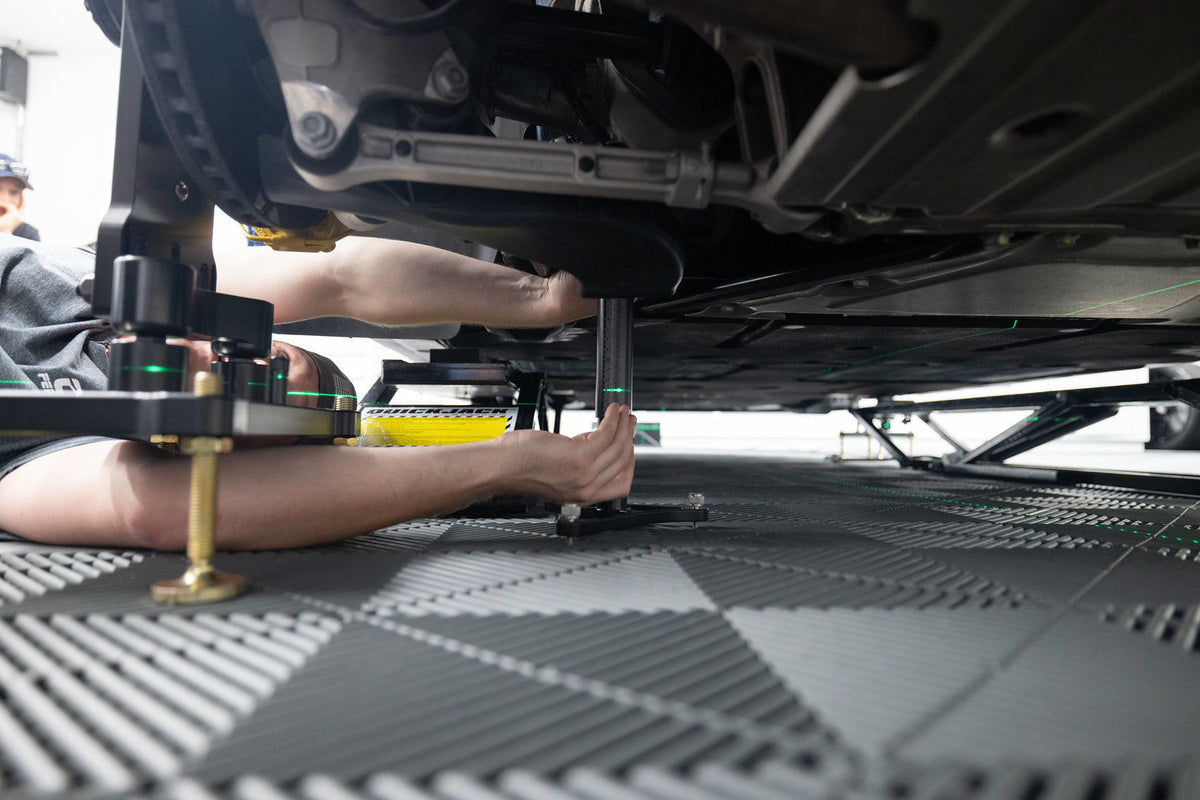
What every alignment and corner-balance adjustment actually does, why it matters, and how to use it. A reference guide for owners, technicians, and shop builders working on performance cars.
Why this guide exists
Most setup advice on the internet is a list of numbers. Run -2.5° front camber. Set rear toe to +0.10°. Coilovers at click 12. The numbers are useful, but they don't tell you why, and without the why you can't adapt them. Different car, different tire, different track, different driver, and the numbers are wrong.
This guide works the other direction. It walks through every adjustment you can make to a typical performance car suspension, what it actually does to the chassis dynamically, and how to think about it when you're chasing a specific handling problem. The cars referenced are the kind we work with every day: Porsches (911, 718, GT3, GT4), Corvettes (C7, C8, Z06, ZR1), BMW M cars (M2/M3/M4 with double-joint front struts), Cayman-platform race cars, and similar high-performance double-wishbone or strut-based chassis.
If you understand what each adjustment does, you stop chasing recipes and start solving problems.
The fundamental principle behind suspension tuning is tire load sensitivity.
Tires do not gain grip in direct proportion to load. If one tire gains more load while the opposite tire loses the same amount, the pair produces less total grip than before. Nearly every suspension adjustment changes handling by either changing how load is distributed between the tires or by changing how effectively the tires convert that load into grip. Keep this in mind through the rest of this article.

The four jobs of a suspension
Before talking about adjustments, understand what a suspension is actually trying to do. There are four jobs, and they fight each other constantly:
- Keep the tire in contact with the road. The contact patch is everything. Anything that lifts, unloads, or skips the tire across the surface costs grip.
- Keep the tire's contact patch flat to the ground when the chassis is loaded in cornering, braking, or acceleration. A tire makes peak grip when its contact patch is square and evenly loaded.
- Distribute load between the four tires in a predictable, controllable way. The driver wants the car to rotate, grip, and recover smoothly without surprises.
- Communicate to the driver what's happening at the contact patch through steering feel, chassis attitude, and feedback at the limit.
Every adjustment below is some compromise between these four goals. Move one, you move the others.
Camber
What it is: The angle of the wheel relative to vertical, viewed from the front of the car. Top of the wheel leaning inward toward the chassis is negative camber. Top leaning outward is positive camber. Performance cars run negative; race cars run a lot of negative.

What it does: Negative camber makes the tire's contact patch flat to the ground when the chassis rolls in a corner. As you turn into a corner, weight transfers to the outside tires and the chassis rolls. That roll tilts the outside tire so its outside edge is more loaded than its inside edge. Static negative camber pre-tilts the wheel inward, so when the chassis rolls, the contact patch lands flat instead of riding on its outer edge.
How it affects handling:
- Cornering grip increases with appropriate negative camber, up to the point where the tire can use it. Past that point you're just running on the inside edge in a straight line and only the outside edge in corners, which costs you both.
- Straight-line braking degrades with too much negative camber. You're standing the tire up on its inside edge under braking, reducing the contact patch.
- Tire wear shifts inward with negative camber, especially on the front. Daily-driven cars with -3° front camber will eat the inside shoulder of a street tire in months.
- Steering feel sharpens with more front negative camber, especially on initial turn-in.
How to know you have it right: Tire pyrometer readings across the tread, taken within one lap of leaving the track. Inside, middle, outside. Spread should be under 15°F to 20°F across the three points. If the inside is hottest, you have too much camber. If the outside is hottest, not enough. Consistent across all three means you've matched camber to the tire. If the middle is the hottest, look at tire pressures.
Front-to-rear relationship matters as much as the absolute number. A car with -2.0° front and -1.5° rear (front more negative) will typically rotate more than a car with -1.5° front and -2.0° rear (rear more negative).
Caster
What it is: The forward-or-rearward tilt of the steering axis when viewed from the side of the car. Imagine a line drawn through the upper and lower steering pivots (or strut top mount and lower ball joint). If that line tilts rearward at the top, you have positive caster. Performance cars use 6° to 10° of positive caster typically.

What it does: Two things, both important.
First, caster creates a self-centering effect on the steering. The wheel wants to return to straight after you turn it. More caster, more return-to-center force.
Second, and more importantly for performance: caster causes the outside wheel to gain negative camber dynamically as you steer into a corner. Turn the wheel and the outside front rolls onto more negative camber while the inside front rolls toward positive. This is why a car with high caster can run less static camber and still keep the contact patch flat mid-corner. The caster does the work in the transient, and the payoff shows up everywhere else: less static camber means a flatter tire under straight line braking, and more grip when you need it most.
How it affects handling:
- Steering effort increases with more caster. Cars with 9°+ caster need power steering or strong forearms.
- On-center steering feel improves with more caster. The wheel returns to center confidently, the car tracks straight under throttle.
- Dynamic camber gain in cornering increases with caster. The front outside tire develops more negative camber the harder you turn, which is exactly when you need it.
What most people get wrong: Caster is often treated as "set it and forget it" because on many cars it's not directly adjustable. But on cars where you can adjust it (most race cars, and Porsches with shimmable LCAs or thrust arm bushings), caster lets you decouple static camber from dynamic camber. Two cars with -2.5° static camber but different caster will behave very differently mid-corner. The car with higher caster will gain more camber as it turns, working better with stiff sidewall race tires.
Side note: Caster split (different left vs right) is sometimes used on oval cars to make the car turn left more easily. On road-course cars, you typically want left and right caster matched within 0.2°. A large caster difference side to side would lead to uneven dynamic camber changes left to right.
Toe
What it is: The horizontal angle of the wheels viewed from above. Wheels pointing inward at the front (closer together at the front than the rear of the tire) is toe-in. Pointing outward is toe-out. Toe is the most sensitive adjustment on the car: tiny changes (single arc-minutes, sub-millimeter) make noticeable differences in feel.

What it does: Toe controls stability vs responsiveness. Toe-in stabilizes the axle. Toe-out makes it dart. The mechanism is geometric: when the chassis loads or rolls, toe-in tries to steer the car straight, while toe-out tries to steer it deeper into the corner.
Front toe-in:
- Highway stability improves
- Turn-in response slows (the car feels lazy on entry)
- Tire wear shifts to the outside shoulder
- Most factory specs use slight front toe-in for safety
Front toe-out:
- Turn-in response sharpens dramatically
- The car tramlines on grooved highways and follows ruts
- Inside shoulder wears faster
- Highway stability degrades; the car wanders
- Race cars run front toe-out almost universally
Rear toe-in:
- Stabilizes the rear axle under braking and at speed
- Reduces rotation (more understeer)
- Helps mid-engine and rear-engine cars feel planted
- Almost every performance car runs rear toe-in
Rear toe-out:
- Increases rotation, often dramatically
- Makes the car unstable under braking and over bumps
- Rarely used outside of specific drift or autocross applications
- Sometimes used in FWD applications
The toe paradox: Most setup time is spent on camber, but toe makes a bigger difference to how the car feels lap-to-lap. A car with great camber and bad toe will feel wrong. A car with mediocre camber and good toe will feel okay. If you're chasing a handling complaint, check toe first.
Ride height and rake
What ride height is: The distance from the ground to a fixed reference point on the chassis.
What rake is: The difference between front and rear ride height. Most cars are designed with positive rake (rear higher than front) for aerodynamic and packaging reasons.
What it affects:
- Static camber. Lower the car and you typically gain negative camber as the control arms swing through their geometry.
- Aerodynamic balance. Reducing rake (nose-down attitude) shifts aerodynamic balance forward, producing more front downforce. This is why prototypes and modern GT cars run such aggressive rake.
- Front-to-rear weight bias. Lowering one end slightly changes the chassis attitude. Any change in static weight distribution is typically very small.
The rake rule of thumb: If a car understeers and you've already addressed camber and toe, look at rake. Adding rake (lowering the nose or raising the rear) shifts grip toward the front: aero balance moves forward and the front works harder. Too little rake and the car pushes. Too much and the rear goes light and the car turns loose, especially at high speed. Small steps matter here; a few millimeters of rake change is a real setup change, not a cosmetic one.
What most people get wrong: Lowering the car for looks. Lowering past the geometric design point of the suspension hurts handling, doesn't help it. Most factory ride heights are within 10mm to 25mm of the optimum for performance. Going lower than that needs new geometry (camber plates, roll center adjusters, bump steer kits) to keep the suspension working correctly.
Spring rate
What it is: The stiffness of the springs, measured in lb/in or N/mm. Higher number, stiffer spring.
What it does: Springs control how much the chassis moves in response to loads (cornering, braking, acceleration, bumps). Stiffer springs reduce body motion. Softer springs absorb bumps better.
How it affects handling:
- Body roll decreases with stiffer springs, which keeps camber more consistent through the corner.
- Pitch under braking and squat under acceleration decrease with stiffer springs.
- Mechanical grip on bumpy surfaces decreases with stiffer springs. The tire skips instead of following the surface.
The stiffer end loses grip is the rule that unlocks spring and bar tuning, and it trips people up because stiffer intuitively sounds like more planted. The mechanism: total lateral load transfer in a corner is fixed by CG height, track width, and cornering force. Springs and bars don't change how much transfers, only how it's split between the axles. The stiffer axle takes a bigger share, its outside tire gets loaded harder, and because tire grip doesn't scale linearly with load, that axle gives up grip. Both ends of the seesaw move together: stiffen the rear and the rear takes more of the transfer while the front is relieved, so the front gains grip exactly as the rear loses it. The balance shifts toward oversteer from both directions at once. Stiffer rear, looser car. Stiffer front, tighter car. Every spring and bar decision on the car is downstream of that one rule.
Read that paragraph twice. It's the single most important concept in chassis tuning.
Practical guideline: If a car oversteers, stiffen the front (or soften the rear). If it understeers, stiffen the rear (or soften the front). Relative balance matters more than absolute rate.
Damper (shock) settings
What dampers do: Springs control how much the chassis moves; dampers control how fast it moves. Specifically, dampers convert the kinetic energy into heat to prevent oscillation. Without dampers, every bump would set the car bouncing for ten seconds.
The four-way matrix: Modern adjustable dampers have up to four independent adjustments per corner:
- High-speed compression (HSC): Resistance to fast compression events. Curbs, sharp bumps, kerbs.
- Low-speed compression (LSC): Resistance to slow compression events. Body roll into corners, brake dive, throttle lift.
- High-speed rebound (HSR): Resistance to fast extension after a bump. Recovery off curbs.
- Low-speed rebound (LSR): Resistance to slow extension. Body recovery after a corner, weight transfer rate when you lift.
How damper settings affect handling:
- Stiffer LSC at the front: Sharper turn-in, more brake dive resistance, but also more understeer if the front tire can't follow surface texture
- Stiffer LSR at the front: The nose stays down longer after braking and turn-in, which holds front geometry through the corner.
- Stiffer LSC at the rear: Less squat under throttle, but also less mechanical grip out of slow corners
- Stiffer LSR at the rear: Holds the rear down longer after lifting off the gas, can feel locked-down
- Stiffer HSC anywhere: Skips over bumps and curbs instead of absorbing them
- Stiffer HSR anywhere: Wheel takes longer to recover after a bump, tire is off the ground longer
The 80/20 of damper tuning: Most drivers should focus on low-speed adjustments. Low-speed is where you feel handling balance. High-speed is where you survive curb strikes and impacts. Set high-speed for the worst surfaces you'll see and tune low-speed to balance the car.
Damper rule of thumb for street/HPDE cars: If you're not sure where to start, set everything in the middle of its range and only adjust one click at a time. Half the "damper problems" people chase are actually spring rate or alignment issues being misdiagnosed because dampers are easier to fiddle with.
Anti-roll bars (sway bars)
What they do: An anti-roll bar connects the left and right suspension on one axle. When the chassis rolls in a corner, the bar twists, transferring some of the load from the outside tire to the inside tire. The effect is to reduce body roll on that axle without making the suspension stiffer in straight-line bumps (where both wheels move together and the bar doesn't twist).
Why this matters: Springs control all vertical motion equally. Anti-roll bars control roll specifically. So you can have a car that's compliant over bumps (soft springs) but flat in corners (stiff anti-roll bars). Best of both worlds, mostly.
How they affect balance: Same principle as springs but more isolated. Stiffening the front anti-roll bar reduces roll at the front and increases understeer (less front grip). Stiffening the rear anti-roll bar reduces roll at the rear and increases oversteer (less rear grip).
- Stiffer front bar: More understeer, less front roll, better aero stability on cars with downforce
- Stiffer rear bar: More rotation/oversteer, less rear roll, better turn-in on slow corners
- Softer front bar: Less understeer, more front mechanical grip on bumpy surfaces
- Softer rear bar: Less rotation, more rear stability, better traction out of slow corners
Anti-roll bars vs spring rates for balance tuning: Both can move the balance, but they do it differently. Springs change roll and heave (vertical motion) and pitch (front-to-rear motion). Anti-roll bars only change roll. If a car has the right springs but wrong balance, change the bars. If a car heaves on bumps or pitches under braking, change the springs.
What most people get wrong: Throwing on giant anti-roll bars to "stiffen up" the car. Big bars make a car flat in corners but also make it skittish on bumps because the bar effectively connects the two wheels. Hit a bump with one wheel and the bar tries to lift the other wheel off the ground. On rough tracks, less bar is more.
Corner balance (cross weights)
What it is: The static weight on each individual wheel of the car, with the driver in the seat at typical fuel level. Measured in pounds or kg per corner. Total weight matters less than the distribution.
The metric that matters: Cross weight, calculated as (left front + right rear) / total weight. A perfectly cross-balanced car shows 50.0%. Anything from 49.5% to 50.5% is acceptable on a road course. Off by more than that, and the car turns left and right differently.
Why it matters: A car with uneven cross weights will turn into one direction better than the other. Worse: the alignment readings you take on an unbalanced car are wrong. Camber and toe both shift with weight on the corner, so if you align before balancing, you'll need to align again after.
How to set it: Drop the car on scales (corner weight scales, sometimes called "scale pads"). Adjust spring perches up or down on individual corners to add or remove weight from that corner. Adding perch height adds weight to that corner and to the diagonal corner; removing perch height removes weight from those two corners.
Critical nuance: Corner balancing should preserve target ride height, but small changes are inevitable and should be checked afterward. You're cross-loading the chassis through the springs, not jacking the body up. But to do it right, you need driver weight in the seat (or a sandbag), accurate fuel reference, full tires, all heavy components in their final positions, and a level surface. The stiffer the springs, the less ride height will change with corner balance adjustments.
Recommendation: We recommend sacrificing a bit of perfect cross weight to get the Left Front and Right Front weights within about 40lbs. This helps keep turn-in consistent in both directions.
The order matters: Always corner balance before final alignment. Always.
Tire pressure
The most overlooked adjustment: Tire pressure is free, takes 30 seconds, and changes the handling balance more than most spring rate or alignment changes.
What it does: Pressure controls the shape and stiffness of the tire's contact patch. Higher pressure = stiffer sidewall, smaller contact patch, less rolling resistance, but less ultimate grip. Lower pressure = softer sidewall, larger contact patch, more grip, but more heat buildup and slower response.
How it affects balance: Just like springs and anti-roll bars, increasing tire pressure generally reduces the available grip at that axle once you're above the tire's optimal pressure. Higher front pressures tend to increase understeer, while higher rear pressures tend to increase oversteer. The underlying principle is the same: reducing grip at one axle shifts the handling balance toward the opposite axle.
Hot vs cold pressure: Tire pressures rise as the tire heats up, typically 4 to 6 psi from cold to fully heated. So the cold pressure you set is not the pressure the tire sees on track. Pros set pressures hot, immediately after coming off track, because that's the operating condition that matters. Once you find adjust the hot pressure to what you want, check the cold pressure once it cools down. That is your starting point.
What you adjust to find your pressure: Tire pyrometer readings. If the middle of the tread is much hotter than the inside or outside edges, pressure is too high (tire is crowning). If the edges are hotter than the middle, pressure is too low (sidewalls flexing too much). Typically adjust pressure until the temperature spread across the tire is even within 15°F.
Wheel and tire choices
Strictly speaking, these aren't suspension adjustments. But they affect handling more than most adjustments do, so they belong in this guide.
Tire compound: Drives everything else. A car set up for street tires has totally different alignment and pressure targets than the same car on slicks. Match the setup to the tire, not the other way around.
Tire width: Wider tires = more grip, more rolling resistance, and more weight. Going wider on the front is one of the most effective ways to dial out understeer on cars with stock-width fronts (the 718 platform is a textbook example).
Wheel offset: Lower offset (or higher offset spacers) push the wheel outward, increasing track width. Wider track reduces weight transfer in cornering and increases stability. But it also changes scrub radius, which affects steering feel and braking stability.
Wheel diameter: Bigger wheels with shorter sidewalls give sharper response but ride harder and transmit more bump load to the chassis. Most performance cars are happiest with the original-design wheel diameter and a properly chosen tire.
Wheel construction: Forged wheels are lighter, stiffer, and more expensive than cast. The handling difference of saving 4 lbs of unsprung weight per corner is real and significant. It's equivalent to a substantial spring rate change in terms of how the car follows the surface.
The diagnostic process: how to use this knowledge
The point of understanding what each adjustment does is to be able to walk into the garage with a condition and walk out with the right change. Here's how to think about it.
Start with the condition, not the adjustment
Drivers often arrive in the paddock with a solution: "I need more camber." Maybe. But what does the car actually do that's wrong? Translate the condition into a chassis state.
"Pushes mid-corner" - understeer at steady state - front lacks grip relative to rear. Could be camber, toe, springs, bars, pressure, ride height, rake, all of which we've covered.
"Snaps on power" - oversteer on throttle application - rear loses grip when accelerating. Different fix list: rear toe, rear damper, ride height rake, throttle technique.
"Won't turn in" - understeer at corner entry - front not loading or biting on initial turn. Front toe, front damper LSC, weight transfer rate, brake bias.
Same word ("understeer") can mean three different things based on the condition it is experienced. The fix is different for each.
Change one thing at a time
Sounds obvious. Almost nobody does it. The temptation when a session goes badly is to change three things between sessions. Don't. You'll never know which change fixed the problem (or made it worse). Change one thing, do a session, evaluate. If you're chasing time, this feels slow. It's actually the fastest way to a good setup.
Use data, not feel, when possible
Driver feel is real and valuable. Tire temperatures, pressures, and lap times are objective. Use them together.
Know when to stop
A perfect setup doesn't exist. There's a setup that works well enough for the conditions, and there are diminishing returns past that. If you've corner-balanced the car, set alignment to a reasonable target for your tires, dialed pressure based on pyrometer, and the car is balanced, stop tuning and go drive. Time spent driving teaches you more about a car than time spent fiddling on the lift.
The standard order of operations
Setup work has a correct sequence. Skip a step or do them out of order, and the work upstream gets undone by the work downstream. Here is the order any properly run setup follows, whether you're doing a fresh build, a major suspension change, or a between-session adjustment at the track.
- Verify the car is mechanically sound. Bushings, ball joints, wheel bearings, tie rod ends, sway bar end links, and shock mounts all good. Setup work on a worn chassis chases ghosts.
- Set tire pressures to a consistent reference. Cold pressures equal across each axle. You'll fine-tune later, but every measurement that follows assumes the tires are in a known state.
- Set ride height at all four corners. Front first, then rear (typically). Confirm rake matches your target. Bounce each corner firmly to settle the suspension before measuring.
- Set corner balance (cross weights). Driver weight in the seat (or sandbag), correct fuel level, level surface. Adjust spring perches to bring cross weight within 0.5% of 50/50. Re-verify ride heights afterward; adjust if perches moved them.
- Set camber. Front first, then rear (typically). Match left and right within 0.1° per axle. On cars with shimmable LCAs, plan camber and caster together since adding shims affects both.
- Set caster. Where adjustable. Match left and right within 0.2°. Verify the wheel still has fender clearance at full lock.
- Set toe. Rear first, then front. This is the last alignment adjustment because every previous step moves toe.
- Verify the car still sits at target ride height and cross weight. Aggressive camber and toe changes can subtly shift both. Re-check, re-adjust if needed.
- Drive the car. Read the tires. Pyrometer readings across each tread within one lap of coming off track. Use the data to adjust pressures (first), then alignment (second), then springs/bars/dampers (last).
- Document everything. Every number, every adjustment, every track condition, every set of tire temps. Without records, you can't repeat what worked or undo what didn't. IntelAlign is very helpful for this.
The most common mistakes in this list are skipping step 1 (chasing setup problems on a worn chassis), skipping step 4 (aligning before corner-balancing), and skipping step 10 (no records, can't recreate a good setup next time).
For between-session changes at the track, you don't repeat the whole list. But you do follow the same priority order: pressures and bars are quick adjustments, alignment changes require re-balancing if they're large, and any change to spring rate or ride height starts the process over from step 3.
Closing thought
Suspension tuning has a reputation for being a dark art. It isn't. It's a system of well-understood physical adjustments, each of which does specific things in specific directions. Understand what each does and you can debug almost any handling problem from first principles.
The best setup engineers in motorsport aren't the ones with secret recipes. They're the ones who can take a vague driver complaint, translate it into a chassis state, identify which adjustment moves that state in the direction needed, make exactly that change, and verify it worked. That process is teachable. That's what this guide tries to do.
The numbers in any vehicle-specific setup guide are a starting point. The thinking process in this one is what gets you the rest of the way.
This guide is published by CSM Performance. We design and manufacture precision alignment and setup tooling used by pro race teams, performance shops, and serious owners running these cars at the limit. Our Precision Hub Stands and Laser Alignment System are built for repeatable, measurement-quality alignments on Porsche, Corvette, BMW M, and similar performance platforms. If you're building out a setup capability at home, in a shop, or in the paddock, reach out: info@csmperformance.com.
IMPORTANT DISCLAIMER
The information in this guide is provided for educational and reference purposes only. It describes general principles of suspension and chassis tuning that apply broadly to performance vehicles, but is not a substitute for vehicle-specific service information, factory specifications, or qualified professional inspection.
It is the owner's and installer's sole responsibility to verify that any adjustment applied to a specific vehicle is appropriate for that vehicle's hardware, intended use, tires, wheels, and operating environment. This includes confirming adequate component clearance, suitability of any aftermarket parts installed, and compliance with applicable laws and regulations for street-driven vehicles.
Operating a vehicle outside factory specifications may accelerate wear, alter handling characteristics in ways that require driver adaptation, affect vehicle stability under braking and at speed, and may void portions of the factory warranty. Any modifications described should be performed using properly torqued, properly rated, and correctly installed components.
CSM Performance, the authors, and contributors to this guide make no warranties regarding the suitability of these principles or specifications for any particular vehicle or use case, and assume no liability for any damage, injury, loss, or warranty implications arising from their application. Use at your own risk.


Share:
Hub Stands: How To Make Setup Simple
Setup Order of Operations: The Right Sequence for Chassis Setup