
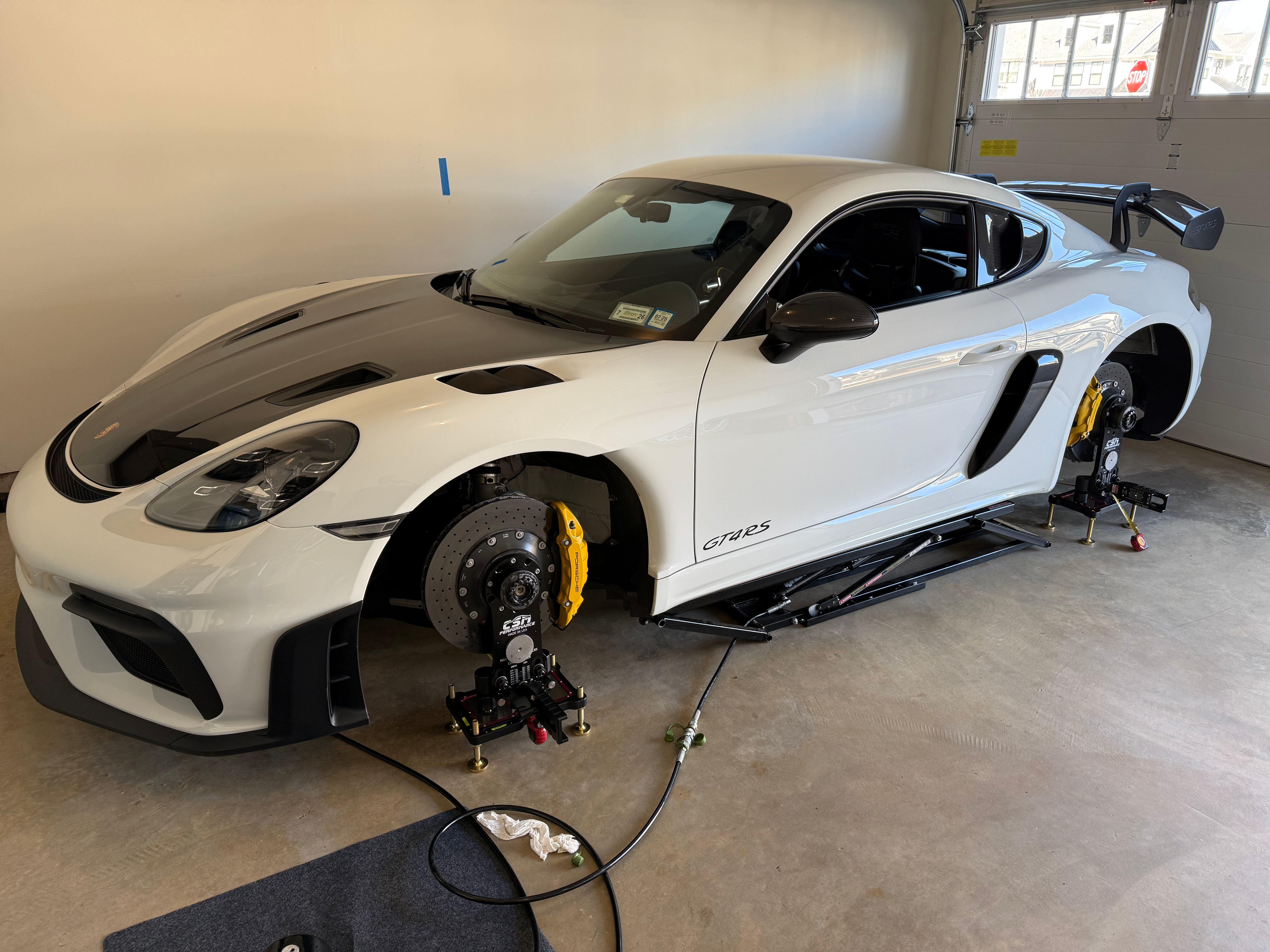
A practical alignment, corner-balance, and chassis tuning reference for the Porsche 718 Cayman GT4 RS (982, MY2022+), including Weissach Package cars. Most of this guide applies equally to the 718 Spyder RS, which shares the chassis. Written for owners and shops running these cars in HPDE, time trial, and dual street/track duty. Factory values cited below should be verified against your car's current documentation; Porsche revises specifications between model years.
What this guide is, and what it isn't
The GT4 RS is the closest thing Porsche has built to a street-legal Cup car on the mid-engine platform. The 9,000 rpm GT3 engine gets the attention, but the chassis is the part that rewards study: RS-specific spring and anti-roll bar rates, a 30mm drop, and a suspension that Porsche ships with adjustable toe, camber, anti-roll bars, and ride height from the factory. Porsche built the adjustability in.
This guide covers what the factory delivered, what the stock hardware can actually do, where the hardware runs out, and how the well-established GT4-platform setup recipe applies to the RS. It is not a substitute for the owner's documentation or Porsche publications. Those are the canonical references. This guide assumes you can get to them and adds the practical context they leave out.
If you want the reasoning behind any adjustment discussed here, our Suspension Setup Fundamentals guide covers what every adjustment does and why. This guide applies that thinking to one specific car.
What's in front of you: the GT4 RS hardware
- Strut front and rear, with a 911 GT front end. The front suspension carries the 991 GT3 front axle lineage the GT4 platform inherited, with RS-specific solid mounting: MacPherson strut, OEM-spec PASM damper hardware, helper springs to keep the mains seated at full droop, and a 7mm wider front track than the GT4 under RS-specific carbon quarter panels. The rear keeps the GT4 layout with RS spring and damper rates and an 8mm wider track, and Porsche's own data sheet confirms the rubber-delete treatment applies to both ends: ball joints for all suspension bushes front and rear, where the GT4 gets them only at some mounts. The lineage matters: the deep GT4/Spyder setup knowledge base transfers, and the whole car is solid-mounted from the factory.
- RS spring rates. Community-documented figures put the RS at 100 N/mm front and 140 N/mm rear, against 45/80 on the base GT4. The front rate more than doubled. Keep those two numbers in mind; they explain several RS-specific behaviors below, including why the classic GT4 anti-roll bar recipe doesn't transfer cleanly to this car.
- PASM adaptive dampers. Two-mode electronically controlled damping with RS-specific calibration. Not click-adjustable like a motorsport damper: your damper tuning happens in software maps, or with an aftermarket controller, not with a knurled knob. Owners who outgrow PASM's envelope on dedicated track cars typically move to click-adjustable motorsport dampers (MCS, Ohlins, KW Clubsport class hardware), which trades the adaptive behavior for direct, repeatable adjustment.
- Adjustable anti-roll bars front and rear. Three end-link positions per bar (soft, middle, stiff), delivered in the middle position at both ends. Record positions before changing anything so you can always return to baseline.
- Camber adjustment at the strut top mounts (slotted) and via spacer shims at the two-piece lower control arm inner mounts, the same mechanism Porsche uses on the Cup cars.
- Toe adjustment via tie rods at the front and eccentrics on the rear track rods. The RS uses a rear toe arm with a greater adjustment range than the standard GT4's: where a stock GT4 typically exhausts rear toe adjustment around -1.3° to -1.7° of rear camber, the RS reaches roughly -2.0° before hitting the same wall. More range on factory parts, not unlimited range.
- Caster The RS deletes the GT4's rubber front caster bushing for a solid-mounted puck, which alone improves steering precision and braking stability.
- Ride height adjustment via spring perches, with the car delivered 30mm lower than a base 718.
- Wheels and tires. 20-inch forged aluminum centerlocks, 245/35 ZR20 front and 295/30 ZR20 rear, with forged magnesium wheels optional as part of the Weissach Package (roughly 10kg of unsprung and rotating mass saved). Michelin Pilot Sport Cup 2 standard.
- Adjustable aerodynamics. Swan-neck rear wing with an extended adjustment range and front diffuser settings. Aero balance is a real setup variable on this car, not a styling feature.
The factory baseline
The shop manual specifies the following alignment values for the GT4 RS and Spyder RS, measured with tires at 2.0 bar front and 2.3 bar rear:
- Ride height: front 109mm, rear 130mm, tolerance +2mm/-0mm (no lower than spec) at the factory measurement points.
- Front toe: +2' toe-in total, tolerance ±2'. Maximum left/right difference 2'.
- Front camber: -1°30', tolerance ±3'. Maximum left/right difference 3'.
- Caster: maximum left/right difference 15' per the RS setup table. Factory dealer printouts on this platform carry a nominal caster around 10°00' with a ±30' window, and owners at track camber settings typically land between 9° and 9.5°.
- Toe-out on turns: 1°22' ±30' at 20° of steering angle, the factory's check on steering geometry.
- Rear toe: +10' toe-in per wheel, tolerance ±2'. Maximum left/right difference 2'.
- Rear camber: -1°45', tolerance ±5'. Maximum left/right difference 5'.
Read those tolerances carefully. Total front toe is specified inside a two arc-minute window. Rear toe per wheel: two minutes. Front camber: three minutes, with left and right required to match within three. Two arc-minutes is roughly 0.03 degrees, about 0.3mm measured across a 20-inch rim. That is the window the factory considers acceptable, and it tells you two things. First, Porsche knows exactly how sensitive this chassis is to toe and camber. Second, any alignment method that cannot repeat measurements inside a couple of arc-minutes cannot even confirm the car is in factory spec, let alone improve on it.
Two clarifications that trip up 4RS owners. First, notation: the manual writes angles in degrees and arc-minutes, and -1°30' is one and a half degrees, not 1.3 degrees. Misread decimal versions of these specs circulate on forums, which is its own small argument for arc-minute literacy. Second, these are specification windows, not adjustment limits. The -1°30' front camber figure does not mean the strut maxes out there. Owners routinely reach around -2.3° of front camber on completely stock hardware with the strut top adjustment run full inboard. The manual tells you what the factory set. The hardware decides what you can set.
Who should leave it alone
If the car is a street car with a few track days a year, the factory alignment is a genuinely good compromise and the RS spring and bar rates already put it well beyond any other 718 in stock form. The honest cost of a track alignment on a street-driven car is inside-shoulder tire wear and some highway wander if you take front toe toward zero or out. If that trade does not sound worth it, run the delivery spec, focus on tire pressures and driving, and come back to this guide when the front tires start telling you the car has more in it.
Stage 1: everything the stock hardware gives you
The free adjustments, in the order they matter:
- Front camber to the stock limit. Slide the strut tops inboard. Expect somewhere around -2.0° to -2.4° depending on the individual car; build variation is real. This is the single biggest grip improvement available on the car and it costs nothing but an alignment.
- Rear camber within the toe constraint. The rear eccentrics have limited range, and here is the platform's known catch: as you add rear camber, you consume rear toe adjustment, because the toe link sits behind the axle line and added camber pulls the toe toward out. Expect the factory arm to run out somewhere around -2.0° while still holding proper toe-in; individual cars have been documented a couple tenths beyond, so build variation and the toe-in you demand move the exact number. Do not sacrifice rear toe-in to chase rear camber. On this platform, rear toe-in is stability under braking, and giving it up is how a fast car becomes a scary one.
- Front toe. For dual duty, zero front toe sharpens turn-in noticeably over the delivery spec while staying civil on the road. Owners split between zero and about 1mm out per side; going past 1mm per side is a lot of toe-out for a car that sees the street
- Anti-roll bars. The classic GT4 recipe of front bar soft, rear bar stiff exists to fight understeer on a car with 45 N/mm front springs that roll heavily onto the outside front. The RS has 100 N/mm front springs; the problem the recipe fixes is already half fixed. RS owners with a proper alignment consistently converge back to middle/middle, with one hole stiffer on the rear as a rotation aid; a stiffer rear bar adds rotation quickly on this car, and most settle back near the middle. Treat bars as trim: fix camber first, change one hole at a time.
- Corner balance. The perches are adjustable. Driver weight in the seat, consistent fuel load, cross weight to 50.0%. One catch specific to GT cars: the factory sway bar end links are fixed length, so once perch heights differ side to side, the bars carry preload, and a preloaded bar quietly distorts both your corner weights and your handling balance. Disconnect the end links while balancing, and know that a meaningful ride height change really wants adjustable links so the bars can be re-neutralized afterward. Balance always comes before final alignment. The fundamentals guide covers the full order of operations.
Stage 2: where the hardware runs out, and what fixes it
The GT4 platform has one of the most mature aftermarket setup ecosystems of any modern chassis, and because the RS shares the architecture, the recipe carries over:
- Lower control arm shims (front and rear) are the primary tool for camber beyond the strut tops. Around 7mm of shim reliably reaches -2.5° front, and some cars see -2.6°, but past roughly -2.5° the side effects stack up: caster drifts out of spec, the hub moves forward enough to rub fender liners, and the shims add track width. Plan camber and caster together. Two physical limits cap how far shims can go on stock parts: the factory LCA studs run out of length under a tall shim stack, and the stock tie rods run out of thread engagement around -2.2° at zero toe. Both have extended aftermarket solutions, and both should be checked, not assumed, any time the shim stack grows.
- Adjustable rear toe links unlock rear camber past the factory arm's ~-2.0° practical limit by restoring toe range, and the offset designs meaningfully reduce the platform's rear bump steer, which owners feel directly as reduced high-speed braking wiggle. Until they are installed, the working rule is run generous rear toe-in, and if braking stability is marginal, add more before touching anything else.
- Spring rate changes are the deeper fix for the braking wiggle, and the mechanism is worth stating precisely. Spring rates don't change how much load leaves the rear axle under braking; that's set by deceleration, CG height, and wheelbase. What they change is travel: the same load transfer compresses or extends each axle by the load change divided by the spring rate. Under hard braking the nose dives, adding transient front toe-out, while the rising rear loses toe-in, exactly the geometry change that makes the rear squirm. A stiffer front spring reduces dive and the transient toe-out that comes with it: owners running 120 N/mm fronts on the factory dampers report the wiggle disappears and trail-braking confidence improves, and Manthey's kit raises the front rate by that same 20%. Rear toe-in remains the unanimous first-line fix before any spring comes off the car.
- Adjustable sway bar end links earn their place the first time the car is corner balanced or the ride height moves. They let the bars be set to zero preload at the final ride height and corner weights, which fixed links cannot do. Cheap, unglamorous, and one of the highest value-per-dollar parts on this list.
- Front camber plates become necessary when front camber targets pass what shims can deliver cleanly. They add roughly a degree of range, they correct the caster that shims disturb, and they are mandatory if a wider front tire enters the picture for clearance reasons.
- Caster hardware (adjustable pucks, thrust arm bushings, or adjustable arms) restores caster authority as camber shims push it out.
- The front tire is the deepest fix for understeer on any GT4-platform car. The 245 front section is the built-in handicap, and going wider transforms the balance in a way no bar setting can. It is also the most expensive path, requiring wheels, plates, and fender clearance work, which is why the order is: camber, toe, bars, then tire.
The thresholds, in one place: adjustable rear toe links above about -2.0° rear camber. Front camber plates and caster correction above about -2.5° front. Rear camber plates above about -2.7° rear, which is also where the tire starts protruding past the arch. The adjustment chain is strut tops, shims, plates, and adjustable links.
Baseline targets by use case
These are consensus ranges from the GT4/RS owner and shop community, not factory figures. They are starting points to be tuned with pyrometer data, not destinations:
- Street with occasional track: front camber at the stock-hardware max (around -2.0° to -2.3°), rear -1.8° to -2.0°, front toe zero, rear toe-in at or slightly above delivery spec, bars at the delivered middle/middle.
- Dual duty: front -2.5°, rear -2.0° to -2.25°, front toe zero, rear toe-in roughly 1.5mm to 2mm per side, caster around 9.3°, bars middle/middle. This is the most commonly documented "transforms the car" setup on the platform and generally requires shims plus adjustable rear toe links.
- Dedicated track: front -3.0° to -3.4°, rear -2.5° to -2.8°, front toe zero to slightly out, rear toe-in 1.7mm to 2mm per side, bars middle/middle to one hole stiffer rear. Worth knowing: Michelin's published camber window for the Cup 2 R tops out at -3.0°, so the far end of this range is beyond the tire maker's own guidance, run knowingly by owners chasing the last of it. At this level the parts list includes camber plates, caster correction, toe links, and usually a spring change, and the car should be corner-balanced with the driver and documented session to session.
Read tire temperatures to confirm any of this. Inside-to-outside spread across each tread tells you whether the camber matched the tire; middle-versus-edges tells you pressure. The interpretation framework is in the fundamentals guide.
Tire pressures
One distinction first: the 2.0/2.3 bar figures in the factory alignment table are measurement conditions, the pressures the geometry is specified at, not running targets.
Owners on this car mostly converge around 32 to 35 psi hot, and it is worth knowing that Manthey's own experience-program cars run notably lower, around 1.9 bar front and 2.0 bar rear hot, so there is real usable range at the low end for cooler conditions and cleaner tracks.
Work the pressures the professional way: set a cold starting point, run, and bleed down to your hot target rather than guessing a large cold offset. The staggered widths matter here; the 245 front is the grip-limited axle on this chassis, takes the shoulder abuse whenever camber is short, and is the axle to watch on the pyrometer. Middle hotter than the edges means too much pressure; edges hotter than the middle means too little.
Known issues worth knowing about
Braking toe steer. Under hard braking, deflection in the front thrust arm bushings adds toe-out exactly when you want stability, felt as wandering on the brakes. Solid thrust arm bushings address it directly, which is part of why they appear in every serious setup package for this platform.
PASM harshness at the rear. A common owner complaint is a bouncy, skippy ride on imperfect surfaces, worst at the rear, consistent with the diagnosis that the OEM dampers, revalved GT4 units, struggle to control the 140 N/mm rear spring. Owners address it by softening the rear spring (100/120 or 110/130 setups), with software (aftermarket controller files), or with the full coilover path. Worth knowing before attributing every rough-surface complaint to tires or alignment.
The measurement standard this car demands
Every number above assumes you can measure it. The rear toe tolerance is ±2 arc-minutes and the front camber tolerance is ±3. The difference between a stable rear end and a nervous one under braking on this platform can be less than a millimeter of toe. Strings, toe plates, and camber gauges referenced off wheel faces carry wheel runout and mounting variance that can exceed the entire factory tolerance window before the measurement even starts. Whatever tooling you use, the requirement stands: if the method cannot repeat inside the factory window, the numbers on the alignment sheet aren't valuable.
Closing thought
Porsche shipped the GT4 RS with a fully adjustable chassis and a conservative alignment. That is not a contradiction; it is an invitation. The adjustability exists because Porsche knows what the car does when someone uses it. The gap between those two states, measured properly and adjusted in the right order, is one of the largest free performance gains available on any modern production car.
This guide is published by CSM Performance. We design and manufacture precision alignment and setup tooling used by pro race teams, performance shops, and serious owners running these cars at the limit. If you're building out a setup capability for a GT4 RS at home, in a shop, or in the paddock, reach out: info@csmperformance.com.
IMPORTANT DISCLAIMER
The information in this guide is provided for educational and reference purposes only. It is not a substitute for vehicle-specific service information, factory specifications, the owner's documentation, or qualified professional inspection. Factory values change between model years and revisions; always verify against your vehicle's current documentation.
It is the owner's and installer's sole responsibility to verify that any adjustment applied to a specific vehicle is appropriate for that vehicle's hardware, intended use, tires, wheels, and operating environment. This includes confirming adequate component clearance, suitability and correct installation of any aftermarket parts, sufficient thread engagement on adjustable links at aggressive settings, proper torque on all fasteners, and compliance with applicable laws and regulations for street-driven vehicles.
Operating a vehicle outside factory specifications may accelerate wear, alter handling characteristics in ways that require driver adaptation, affect vehicle stability under braking and at speed, and may void portions of the factory warranty. Setup changes should be validated incrementally in safe, controlled environments before being pushed to the limit.
CSM Performance, the authors, and contributors to this guide make no warranties regarding the suitability of these principles or specifications for any particular vehicle or use case, and assume no liability for any damage, injury, loss, or warranty implications arising from their application. Use at your own risk.


Share:
Camber Deep Dive
Why Hub Stands?