
Millimeters, inches, minutes and degrees: what each one actually measures, how to convert between them, and why two setup sheets with the same number can describe different cars.
Toe is an angle
Toe is the direction the wheel points, viewed from above, compared with the car's centerline. Point the front of the wheel in toward the car and it's toe-in. Point it out and it's toe-out.
That direction is an angle. Every unit you'll see on a setup sheet is a way of describing that one angle, and they fall into two families:
- Angles: degrees and minutes. These describe the angle directly.
- Lengths: millimeters and inches. These describe how far apart the front and back of the wheel are from where they'd be at zero toe, measured across a reference diameter.
Angles mean the same thing on every car. Lengths only mean something once you know the diameter they were measured across.
Degrees and minutes
A degree is divided into 60 minutes, written with a prime: 60′ = 1°. So:
- 0.1° = 6′
- 0.05° = 3′
- 10′ = 0.167°
Converting between the two is plain arithmetic: multiply degrees by 60 to get minutes, divide minutes by 60 to get degrees. Neither one depends on the car, the wheel or the tire. A tenth of a degree is a tenth of a degree on a Miata and on a GT3 Cup car.
Millimeters and inches
A length of toe is the difference across the wheel: how much closer together (toe-in) or further apart (toe-out) the front edge is than the back edge, compared with zero toe. Picture a string running parallel to the car's centerline. Rotate the wheel by the toe angle and the front of the wheel either gets closer to or further away from the string. The difference between the distance from the string to the front of the wheel and the distance to the rear of the wheel is the toe as a length, in millimeters or inches.
For a fixed angle of toe, a 15 in wheel will have a different measurement in millimeters or inches than a 20 in wheel. On the 20 in wheel the measurement is taken over a longer distance, so the same angle reads as a bigger number.
| Wheel | 1 mm of toe is | In minutes |
|---|---|---|
| 15 in | 0.150° | 9.0′ |
| 16 in | 0.141° | 8.5′ |
| 17 in | 0.133° | 8.0′ |
| 18 in | 0.125° | 7.5′ |
| 19 in | 0.119° | 7.1′ |
| 20 in | 0.113° | 6.8′ |
| 21 in | 0.107° | 6.4′ |
One millimeter on an 18 in wheel is about 11% more toe than one millimeter on a 20 in wheel. Move a setup from one wheel size to the other without converting and you've changed the toe.
Toe in millimeters is more common than toe in inches.
Not every sheet uses the wheel
The wheel diameter isn't the only reference people use. Some methods, like toe plates, measure lengths across the tire's outside diameter, which is bigger than the wheel, so the same angle reads as more millimeters. Others use a fixed, standard reference diameter regardless of the car.
None of these is wrong. They're different conventions, and a length of toe is only complete when you know which one it uses. If a setup sheet gives toe in millimeters or inches and doesn't say what it was measured across, ask before you copy the number.
Converting between the families
To turn a length into an angle you need the reference diameter. With the length and the diameter in the same units:
- Angle = arctan(length ÷ diameter)
- Length = diameter × tan(angle)
At toe settings the angle is tiny, so a simpler version is accurate enough for any real setup:
- Degrees ≈ 57.3 × length ÷ diameter
Worked example: a setup sheet asks for 2 mm of toe-in per wheel, and the car runs 19 in wheels. The wheel is 19 × 25.4 = 482.6 mm across. 57.3 × 2 ÷ 482.6 = 0.237°, which is 14.2′.
The other way: you want 0.1° of toe on an 18 in wheel (457.2 mm). 457.2 × tan(0.1°) = 0.80 mm. On a 20 in wheel the same 0.1° is 0.89 mm.
Or skip the math: the Toe Converter at the bottom of this page does it for you.
Per wheel or total
This catches out more people than the units do. A toe figure is either:
- Per wheel: the toe of one wheel, measured from the car's centerline.
- Total: the two wheels on an axle added together.
"0.2° total toe-in" and "0.1° toe-in per wheel" are the same setting. Read one as the other and you've doubled or halved your toe.
Our Laser Alignment System works per wheel throughout. If your setup sheet gives a total, halve it for each wheel. If you're not sure which your sheet uses, find out before you adjust anything.
In or out
Toe-in and toe-out are opposite settings, so the direction matters as much as the number. Many sheets write toe-in as positive and toe-out as negative.
The safest habit is to write the direction out: "0.10° in", "1 mm out".
Grid plates and wheelbase
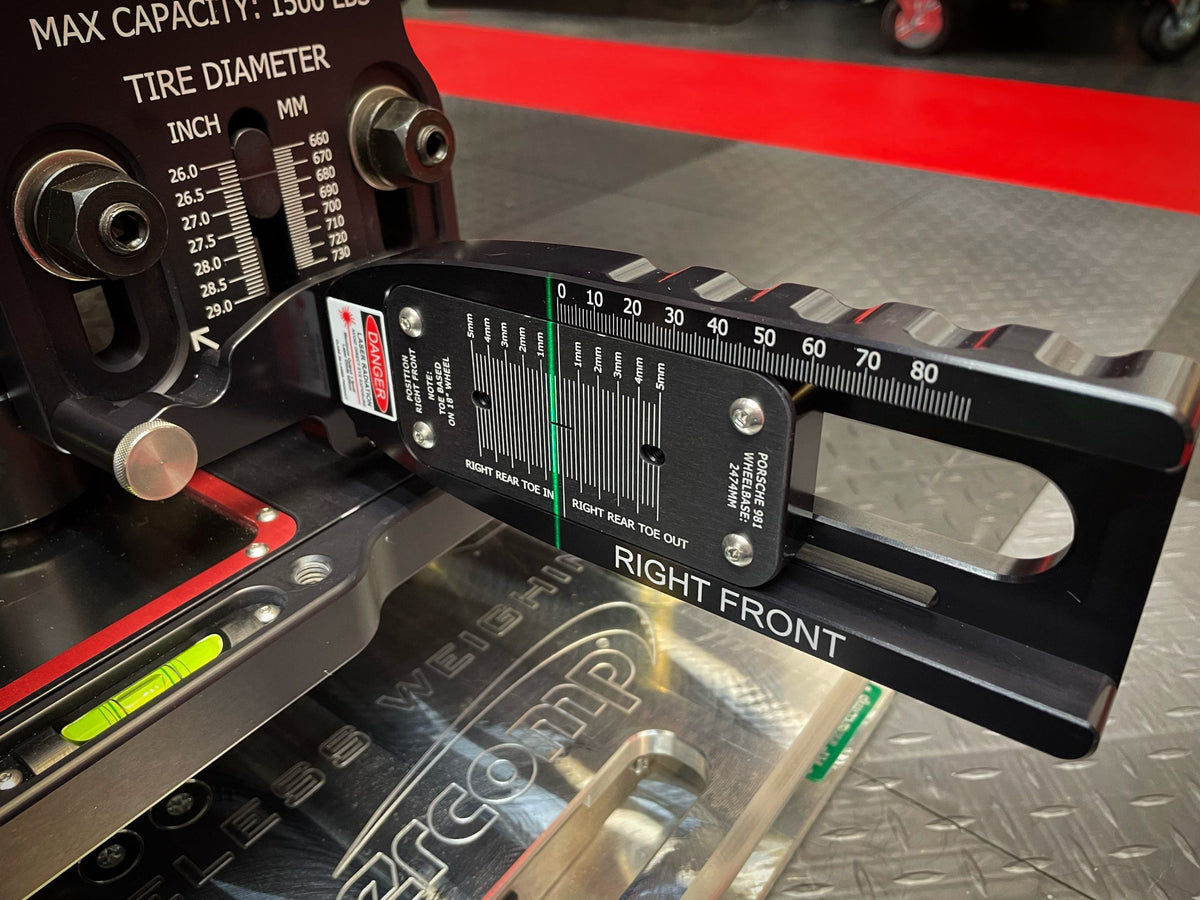
The Laser Alignment System reads toe on a grid plate. A laser on the wheel throws a line forward or back along the car, and the line lands on the plate. The further the plates are from each other (the wheelbase), the further the line moves for the same toe.
That means a grid plate's graduations are drawn for one reference wheelbase. Put a car with a longer wheelbase on it and the line travels further, so the plate reads more toe than the car really has. A shorter car reads less. Linear graduations also carry a reference wheel diameter, for the reasons above.
The Grid Plate Converter does that math for you. Enter the plate, your car's wheelbase and wheel size, and the toe you want, and it tells you where on the plate each laser line should fall.
Which unit should you use?
Whichever your setup sheet uses. The unit doesn't make a car faster. What matters is that everyone working on the car uses the same convention, every time:
- The unit: millimeters, inches, minutes or degrees.
- The reference, if it's a length: wheel diameter, tire diameter or a fixed reference.
- Per wheel or total.
- The direction: in or out.
Write all four on your setup sheet. If you share setups between cars on different wheel sizes, angles travel between them unchanged; lengths need converting.
Quick reference
- 60′ = 1°. 0.1° = 6′.
- 25.4 mm = 1 in.
- 1 mm per wheel on an 18 in wheel ≈ 0.125° ≈ 7.5′.
- Degrees ≈ 57.3 × length ÷ wheel diameter (same units).
- Total toe = left + right. Per wheel = total ÷ 2.
- Always write the direction: in or out.
- Convert any figure with the Toe Converter below.
Toe Converter
Convert one wheel's toe between millimeters, inches, minutes and degrees. Lengths are measured across the wheel diameter.
- Millimeters
- 1.00 mm
- Inches
- 0.039 in
- Minutes
- 7.5′
- Degrees
- 0.125°
Per wheel. For a total toe figure, enter the total and read the result as a total. The direction, in or out, doesn't change.


Share:
Corner Weights and Cross Weight: Explained